
The five benefits of LED lamps in railway infrastructure

LED lamps have surged in popularity in recent years. These lamps are becoming available for more and more applications in railway infrastructure as well. Not surprising, since the LED lamp has a long lifespan, is sustainable and robust, and has a low failure risk. Explore our extensive range in the webshop and discover the benefits.
From Tradition to Innovation
The rail infrastructure sector has traditionally been a conventional industry where products have a long lifespan. Systems last for years, sometimes even decades. This means that components need to be replaced periodically to ensure safety and reliability. Good lighting plays a crucial role in this, especially for visibility and safety on and around the railway tracks. Where incandescent bulbs used to be the standard, LED lighting has now become the new norm. Although the initial purchase price is higher, the benefits far outweigh the costs. LED bulbs last much longer and significantly reduce total lifecycle costs, while also contributing to energy efficiency and sustainability - essential in today’s rail infrastructure.
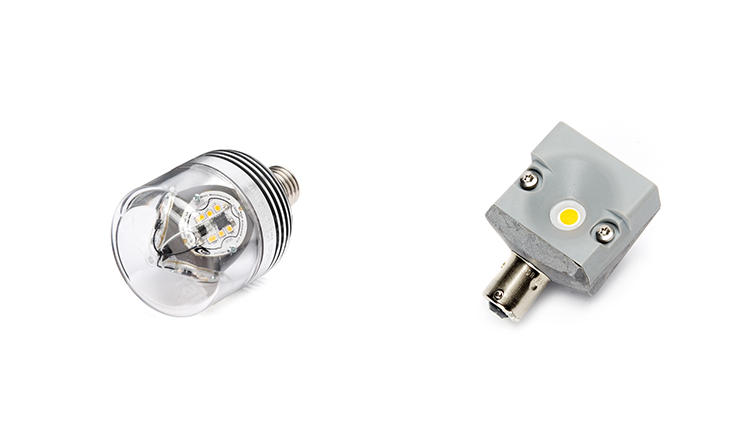
LED vs incandescent: the five advantages
There are countless reasons why LED lights have now become the standard in rail infrastructure.1. Longer lifespan
The LED lamp has a longer lifespan than the incandescent lamp. Under normal use, the lamp lasts at least five years, avoiding costly interim replacements. Incandescent lamps, on the other hand, need to be replaced annually. The longer lifespan of the LED lamp not only saves on material but also reduces maintenance costs.
2. Cost-saving in the long term
Although the purchase of LED lamps is a higher expenditure, they quickly pay for themselves. They last much longer, reducing the need for costly service interruptions and technicians. This lowers the operational costs and increases the availability of the railway.
3. Environmentally friendly and recyclable
LED lighting is more energy-efficient and easier to recycle than traditional incandescent lamps. This aligns well with the sustainability goals of the railway infrastructure for 2025, where circularity and CO₂ reduction are becoming increasingly important.
4. Low failure rate
LED lamps have a much lower risk of failure than incandescent lamps. Failures are almost exclusively due to manufacturing defects or at the end of their lifespan when the light output gradually decreases. The low failure rate of LEDs has been a major incentive for PGO contractors to replace incandescent lamps with LEDs for years.
5. Immediate maximum brightness
LED lamps reach their maximum brightness immediately after being switched on, whereas incandescent lamps require time to warm up. This is crucial for applications in signalling and security lighting, where every second counts.
Light Bulb
Light Bulb | Retrofit LED | Application | Specification |
| 5975641 | 5975650 | High- (AY) or low-mounted (MF) signal | SPC60300-1 appendix 1 |
| 5954208 | 5954300 | Matrix signaler | SPC60300-1 appendix 2 |
| 5913271 | 5913300 | Warning installations WIDO, WIT and WIBR | SPC60300-1 appendix 3 |
| 5962310 | 5962320 | Light guide signals (LLGS) | SPC60300-1 appendix 5 |
| 5939526 | 5975620 | Departure light | SPC60300-1 appendix 6 |
| 5939526 | 5975630 | WUBO | SPC60300-1 appendix 6 |
Are you curious about the possibilities or looking for more information? Visit our webshop or contact our Product Manager Mick van der Heide.

This article was previously published in 2023, this version has been updated to reflect the current situation.